
 09069072051
|
 CALL 07065486363
Are you looking for NECO GCE 2026 Marketing and Answers? You are in the right place.
Welcome to Naijaclass Academy, your trusted online resource for WAEC, NECO, JAMB and other examination preparation materials.
Important: The questions provided on this page are 100% question materials for this Marketing Exam. .
Wednesday, 4th November, 2026
Marketing Paper III (Objective) – 10:00am – 11:00am.
Marketing Paper II (Essay) – 11:00am – 12:40pm.
MARKETING OBJ
01-10: EBCBEBDDEA
11-20: CECDCBCBEA
21-30: BCEACBAABB
31-40: DDDBADCEEA
41-50: CEBEAECCBB
51-60: BBCDEAABEC
COMPLETED
===========================================
NECO GCE 2026 Marketing and Answers
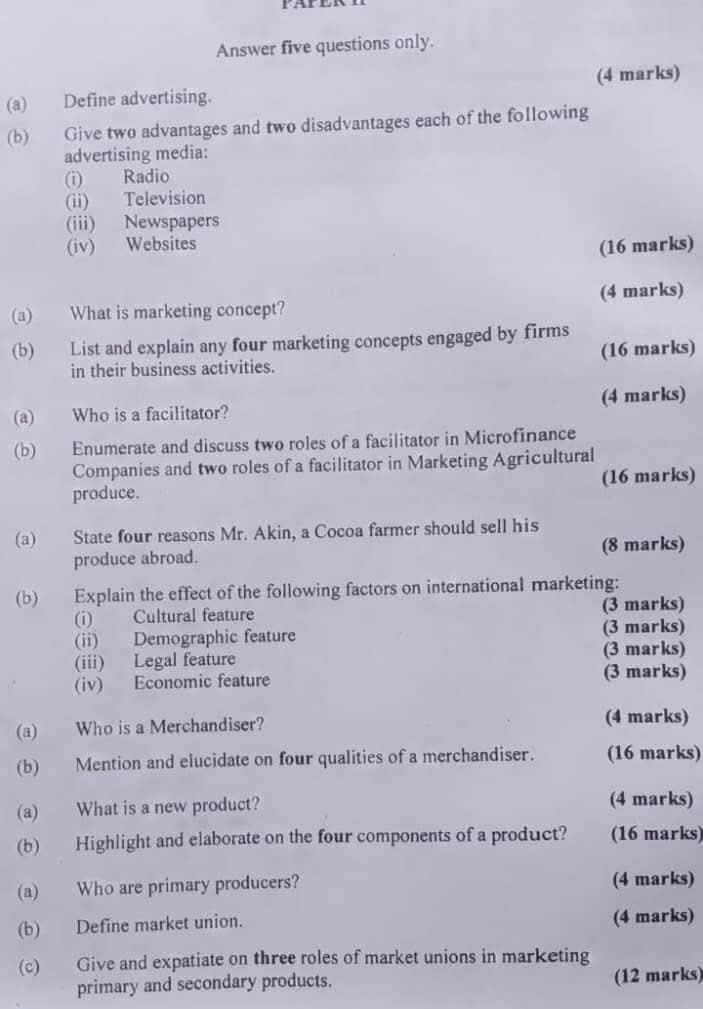
(1a)
Advertising is a form of communication used by individuals, businesses or organisations to inform, persuade and remind the public about the existence, features and benefits of their goods and services in order to attract customers and increase sales.
(1bi)
=Radio=
Advantages
(PICK ANY TWO)
(i) It is relatively cheap compared to television advertising.
(ii) It reaches a large number of people in different locations.
(iii) It can reach people who cannot read or write.
(iv) Advertisements can be repeated frequently to remind listeners about products.
(v) It is portable and can be listened to while working or travelling.
(vi) It allows advertisers to target specific audiences through different radio programmes.
Disadvantages
(PICK ANY TWO)
(i) It does not provide pictures or visual demonstrations of products.
(ii) Listeners may forget the advertisement easily.
(iii) Advertisements have a short lifespan because they are broadcast for a limited time.
(iv) Some people may not have access to radio sets.
(v) Background noise may prevent listeners from hearing the message clearly.
(vi) It may be difficult to explain complicated products through sound alone.
(1bii)
=Television=
Advantages
(PICK ANY TWO)
(i) It combines sound, pictures and motion to attract viewers.
(ii) It reaches a large audience within a short period.
(iii) It makes it possible to demonstrate how a product works.
(iv) It attracts the attention of viewers through colourful images.
(v) It helps to create a strong and lasting impression on consumers.
(vi) It can reach both literate and illiterate people.
Disadvantages
(i) It is very expensive to produce and broadcast advertisements.
(ii) Advertisements are usually shown for a short period.
(iii) Some viewers may change channels during advertisements.
(iv) It requires electricity or batteries to operate television sets.
Disadvantages
(PICK ANY TWO)
(i) It is very expensive to produce and broadcast advertisements.
(ii) Advertisements are usually shown for a short period.
(iii) Some viewers may change channels during advertisements.
(iv) It requires electricity or batteries to operate television sets.
(v) It may not reach people who do not own television sets.
(vi) Producing quality television advertisements requires skilled personnel and equipment.
(1biii)
=Newspapers=
Advantages
(PICK ANY TWO)
(i) It provides detailed information about goods and services.
(ii) It is relatively affordable compared to television advertising.
(iii) It allows readers to read advertisements at their convenience.
(iv) Newspapers can reach a large number of people.
(v) Advertisements can be kept for future reference.
(vi) It allows advertisers to include pictures, prices and contact details of products.
Disadvantages
(PICK ANY TWO)
(i) It cannot reach people who cannot read or write.
(ii) Newspapers have a short lifespan and are often discarded after reading.
(iii) It does not provide sound or moving pictures.
(iv) Some people do not buy or read newspapers regularly.
(v) Advertisements may be overlooked because of many competing adverts.
(vi) Newspaper circulation may be limited to certain geographical areas.
(1biv)
=Websites=
Advantages
(PICK ANY TWO)
(i) It can reach people all over the world.
(ii) It is available to customers at any time of the day.
(iii) It allows advertisers to provide detailed information about their products.
(iv) It is easy to update or modify advertisements.
(v) It allows direct interaction between advertisers and potential customers.
(vi) It can include pictures, videos, animations and links to attract customers.
Disadvantages
(PICK ANY TWO)
(i) It requires internet access to view advertisements.
(ii) Some people do not have the skills to use the internet.
(iii) Advertisements may be ignored or blocked by users.
(iv) It can expose users to fraudulent websites and online scams.
(v) Website advertising may involve high costs of maintenance and promotion.
(vi) Poor internet connection may prevent people from viewing advertisements properly
===============================
(2a)
(PICK ANY ONE)
Marketing concept is a business philosophy that focuses on identifying and satisfying the needs and wants of customers in order to achieve the goals of an organisation and make profit.
OR
Marketing concept is the idea that a business should determine the needs and wants of its customers and provide goods and services that satisfy them better than its competitors while making profit.
(2b)
(PICK ANY FOUR)
(i) Production Concept: This concept focuses on producing goods and services in large quantities at affordable prices. It assumes that customers prefer products that are readily available and inexpensive. Firms that adopt this concept concentrate on improving production methods and reducing the cost of production.
(ii) Product Concept: This concept emphasises the production of high-quality goods and services with improved features, durability and good performance. It assumes that customers prefer products that offer better quality and value. Firms adopting this concept focus on product improvement and innovation.
(iii) Selling Concept: This concept involves using aggressive selling techniques and promotional activities to persuade customers to purchase goods and services. Firms adopting this concept believe that customers may not buy enough of their products unless they are encouraged through advertising, personal selling and sales promotions.
(iv) Marketing Concept: This concept focuses on identifying the needs and wants of customers and providing goods and services that satisfy them better than competitors. Firms adopting this concept carry out market research to understand customers’ preferences and use the information to improve their products and make profit.
(v) Societal Marketing Concept: This concept emphasises satisfying customers’ needs and wants while also protecting the interest and welfare of society. Firms adopting this concept consider public health, environmental protection and the responsible use of resources when producing and selling their goods and services.
(vi) Relationship Marketing Concept: This concept focuses on building and maintaining long-term relationships between a business and its customers. Firms achieve this through good customer service, after-sales services, customer support and loyalty programmes to encourage customers to continue buying from them.
============================================
NECO GCE 2026 Marketing and Answers
(3a)
(PICK ANY ONE)
A facilitator is an individual, group or organisation that assists in making activities or business transactions easier by providing guidance, support, information, resources and necessary services to ensure that a task or process is successfully carried out.
OR
A facilitator is a person or organisation that helps to make a process, activity or transaction easier by providing the necessary support, resources or assistance.
(3b)
Roles of a Facilitator in Microfinance Companies:
(PICK ANY TWO)
(i) Providing Financial Assistance: A facilitator helps individuals, small-scale traders, farmers and business owners to gain access to financial services offered by microfinance institutions. This includes helping them obtain loans and other financial support needed to establish, expand or improve their businesses.
(ii) Creating Awareness: A facilitator creates awareness among members of the public about the services and opportunities available in microfinance companies. These services may include savings accounts, small business loans, insurance and other financial products that can improve people’s standard of living.
(iii) Mobilising Customers: A facilitator helps microfinance companies to identify, attract and register potential customers who need financial assistance. This is usually done through community meetings, business associations, market visits and other awareness programmes, especially in rural areas.
(iv) Assisting in Loan Applications: A facilitator guides customers through the loan application process by explaining the requirements, helping them complete application forms and ensuring that necessary documents are provided. This makes it easier for customers to access loans without unnecessary difficulties.
(v) Financial Education: A facilitator educates customers on the importance of saving money, managing income, controlling expenditure and making proper financial decisions. This helps borrowers to use loans wisely, manage their businesses effectively and avoid unnecessary debts.
(vi) Loan Recovery: A facilitator assists microfinance companies in recovering loans from customers by reminding borrowers about repayment dates and encouraging them to pay their debts as agreed. This helps to reduce loan defaults and enables the company to continue providing financial services to other customers.
(vii) Monitoring and Supervision: A facilitator helps to monitor the activities of customers who have received loans to ensure that the money is used for the purpose for which it was collected. This helps the microfinance company to assess business performance and reduce the risk of loan misuse.
(viii) Building Relationships: A facilitator helps to establish and maintain good relationships between microfinance companies and their customers. Through regular communication, guidance and customer support, the facilitator helps to build trust and encourage customers to continue using the company’s services.
Roles of a Facilitator in Marketing Agricultural Produce:
(PICK ANY TWO)
(i) Linking Farmers with Buyers: A facilitator connects farmers with potential buyers such as wholesalers, retailers, food processing companies, exporters and other agricultural traders. This helps farmers to find markets for their produce and reduces the difficulties involved in selling agricultural products.
(ii) Providing Market Information: A facilitator provides farmers with important information about market prices, consumer demand, available markets and seasonal changes in the agricultural sector. This enables farmers to make informed decisions about what to produce, when to sell and where to sell their products.
(iii) Price Negotiation: A facilitator assists farmers in negotiating reasonable and profitable prices for their agricultural produce. The facilitator helps both farmers and buyers reach an agreement that is beneficial to both parties, thereby reducing exploitation and ensuring fair transactions.
(iv) Transportation and Distribution: A facilitator helps farmers to arrange suitable means of transporting agricultural produce from farms to markets, warehouses, processing industries and other destinations. This ensures that products reach buyers on time and reduces losses caused by poor transportation and delays.
(v) Providing Storage Facilities: A facilitator helps farmers to identify and gain access to suitable storage facilities such as warehouses, cold rooms and silos. Proper storage helps to preserve the quality of agricultural produce, prevent spoilage and reduce post-harvest losses before the products are sold.
(vi) Promotion and Advertising: A facilitator helps farmers to promote their agricultural products through advertising, exhibitions, trade fairs, social media and other promotional activities. This creates awareness about the products, attracts potential customers and increases the chances of making more sales.
(vii) Providing Packaging and Grading Services: A facilitator advises farmers on proper packaging, sorting, grading and labelling of agricultural produce to meet market standards. This improves the appearance and quality of the products and makes them more attractive to consumers and potential buyers.
(viii) Providing Technical Advice: A facilitator provides farmers with useful information and guidance on modern agricultural practices, product handling, preservation and quality control. This helps farmers to improve the quality of their produce, reduce waste and meet the requirements of different markets.
(ix) Arranging Market Linkages: A facilitator establishes connections between farmers, agricultural cooperatives, financial institutions, processing companies and export organisations. These relationships provide farmers with better marketing opportunities and access to larger markets for their agricultural products.
(x) Assisting in Market Research: A facilitator helps farmers to understand consumers’ preferences, market trends and the demand for different agricultural products. This enables farmers to identify profitable opportunities and make better decisions about production and marketing.
==============================================
NECO GCE 2026 Marketing and Answers
(4a)
(PICK ANY FOUR)
(i) Higher Profit: Selling cocoa abroad may enable Mr. Akin to earn more profit because international markets may offer better prices than the local market.
(ii) Larger Market: Selling abroad gives him access to a wider market and more customers in different countries, thereby increasing the demand for his cocoa.
(iii) Foreign Exchange Earnings: Exporting cocoa enables him to earn foreign currencies such as dollars, euros and pounds, which can increase his income.
(iv) Reduction of Local Surplus: Selling cocoa abroad helps to reduce excess supply in the local market and prevents agricultural produce from remaining unsold.
(v) Business Expansion: International sales can increase his income and provide more capital to expand his cocoa farm, purchase modern equipment and employ more workers.
(vi) Diversification of Customers: Selling abroad allows him to deal with different buyers and countries, reducing his dependence on only local customers and markets.
(4bi)
Cultural Feature: Cultural features refer to the beliefs, values, customs, traditions, religion, language and lifestyles of people in different countries. They influence international marketing because customers in different countries may have different tastes, preferences and buying habits. Therefore, marketers must understand and respect the culture of their target markets when designing, packaging, advertising and selling their products.
(4bii)
Demographic Feature: Demographic features refer to the characteristics of a population, such as age, gender, income, occupation, education level, family size and population distribution. These features affect international marketing because they determine the type of goods and services people need and can afford. Marketers must study the population characteristics of a country to identify their target customers and develop suitable products.
(4biii)
Legal Feature: Legal features refer to the laws, rules and regulations guiding business activities in different countries. They affect international marketing because every country has its own regulations concerning importation, exportation, taxation, product standards, packaging and consumer protection. Therefore, international marketers must obey the laws of the countries where they operate to avoid penalties, fines and business restrictions.
(4biv)
Economic Feature: Economic features refer to the financial and economic conditions of a country, including income levels, inflation, exchange rates, employment, purchasing power and economic growth. These factors affect international marketing because they determine the ability of consumers to buy goods and services. For example, countries with high purchasing power may have greater demand for certain products, while economic hardship may reduce consumer spending.
==============================
(5a)
(PICK ANY ONE)
A merchandiser is a person who is responsible for promoting, displaying and selling goods to customers in an attractive manner to increase sales and ensure customer satisfaction.
OR
A merchandiser is an individual who plans, organises and manages the presentation of products in a market or shop to attract customers and encourage them to purchase the products.
(5b)
(PICK ANY FOUR)
(i) Good Communication Skills: A good merchandiser must be able to communicate effectively with customers, suppliers and other workers. This helps the merchandiser to explain product features, answer customers’ questions and provide useful information about goods. Good communication also helps to build trust, maintain good relationships and encourage customers to make purchases.
(ii) Honesty and Integrity: A merchandiser must be honest and trustworthy when dealing with customers and business owners. He or she should provide correct information about products, prices and quality without deceiving buyers. Honesty helps to build customers’ confidence, maintain a good business reputation and encourage customers to continue buying from the business.
(iii) Good Appearance: A merchandiser should maintain a neat, clean and attractive personal appearance when attending to customers. Proper dressing and personal hygiene create a good impression and make customers feel comfortable. A presentable appearance also reflects professionalism and helps to promote a positive image of the business.
(iv) Product Knowledge: A merchandiser must have adequate knowledge of the products being displayed or sold. This includes their features, prices, quality, uses and benefits. Product knowledge enables the merchandiser to answer customers’ questions correctly, recommend suitable products and convince buyers about the value of the goods being offered.
(v) Patience: A good merchandiser must be patient when dealing with different types of customers. Some customers may take time to make purchasing decisions or ask several questions before buying. Patience helps the merchandiser to attend to customers politely, avoid unnecessary arguments and create a pleasant shopping experience that encourages repeat purchases.
(vi) Persuasive Ability: A merchandiser should have the ability to convince customers to buy products without forcing them. This involves explaining the advantages, usefulness and benefits of the products in a convincing manner. Good persuasive ability helps to attract customers, increase product demand and improve the sales performance of the business.
(vii) Good Customer Relations: A merchandiser must be friendly, polite and respectful when dealing with customers. He or she should listen to customers’ complaints, respond to their needs and provide helpful assistance. Maintaining good customer relations creates customer loyalty, encourages repeat purchases and helps the business to attract new customers through recommendations.
==========================================
(6a)
A new product is a good or service that has been recently introduced into the market for the first time or an improved version of an existing product with new features, quality, design or benefits to satisfy customers’ needs and wants. It is developed to meet changing consumer demands, solve problems and create new market opportunities.
(6b)
(PICK ANY FOUR)
(i) Core Benefit: This refers to the basic value, satisfaction or problem-solving benefit that a customer expects from purchasing a product. It is the main reason why customers buy a particular product. For example, the core benefit of purchasing a mobile phone is communication, while the core benefit of buying food is the satisfaction of hunger.
(ii) Basic Product: This refers to the actual physical goods or services offered to customers to satisfy their needs. It includes the essential features, design, quality, brand and packaging of the product. For example, a mobile phone has a screen, battery, camera, speaker and other physical features.
(iii) Expected Product: This refers to the qualities, features and conditions that customers normally expect when purchasing a particular product. These include acceptable quality, reasonable price, good appearance, durability and proper functioning. For example, customers buying a refrigerator expect it to cool and preserve food properly.
(iv) Augmented Product: This refers to additional benefits or services provided by a seller beyond the basic expectations of customers. These may include free delivery, warranties, after-sales services, installation, maintenance and customer support. These extra benefits help a company attract customers and gain an advantage over competitors.
(v) Potential Product: This refers to all the possible improvements, modifications and additional features that a product may receive in the future. It involves introducing new ideas, advanced technology and innovations to improve the product and satisfy changing customer needs.
(vi) Product Support Services: These are additional services provided by a company to assist customers before, during and after purchasing a product. They include technical assistance, repairs, maintenance, customer care, product information and replacement services. They help to improve customer satisfaction and encourage customers to remain loyal to the company.
==========================================
(7a)
(PICK ANY ONE)
Primary producers are individuals or organisations that are directly involved in the production of raw materials from natural resources through farming, fishing, forestry and mining for consumption or further processing.
OR
Primary producers are people who engage in the extraction and production of basic raw materials from nature. They include farmers, fishermen, hunters, miners and lumberjacks who produce goods for sale or further processing.
(7b)
(PICK ANY ONE)
A market union is an association of traders, farmers or producers who come together to protect their common interests, promote their businesses and solve problems affecting their marketing activities.
OR
A market union is an organised group of people involved in buying and selling who work together to regulate market activities, protect members’ interests and improve the conditions of trading.
(7c)
(PICK ANY THREE)
(i) Protection of Members’ Interests: Market unions protect their members against unfair treatment, exploitation and unnecessary charges. They ensure that members receive fair treatment from buyers, sellers and government authorities. They also speak on behalf of members when problems arise and help to defend their rights in the marketplace.
(ii) Price Regulation: Market unions help to maintain reasonable and fair prices for goods sold in the market. They may provide members with information about prevailing market prices and discourage unnecessary price manipulation. This helps producers and traders to avoid selling their products at extremely low prices or charging unfair prices to consumers.
(iii) Provision of Market Information: Market unions provide members with useful information about the availability, demand and prices of products in different markets. This helps farmers, producers and traders to know where and when to sell their goods. It also enables them to make better marketing decisions and reduce possible losses.
(iv) Settlement of Disputes: Market unions help to settle disagreements among members and other traders in the market. They provide a platform where complaints can be discussed and resolved peacefully. This helps to maintain unity, cooperation and peaceful business relationships among people involved in marketing activities.
(v) Promotion of Members’ Products: Market unions help members to create awareness about their products and attract more customers. They may organise exhibitions, trade fairs and other promotional activities. This increases the visibility of members’ goods, encourages sales and helps producers and traders to expand their businesses.
(vi) Provision of Financial Assistance: Some market unions assist members by providing loans, contributions or financial support when necessary. This helps traders and producers to obtain money for purchasing goods, transporting products and expanding their businesses. It also enables members to overcome temporary financial difficulties.
(vii) Maintenance of Market Orderliness: Market unions help to maintain cleanliness, discipline and proper arrangement of goods in the market. They encourage members to obey market rules and regulations, dispose of refuse properly and maintain a healthy trading environment. This makes the market safe and attractive to buyers and sellers.
======================================
*NECO GCE MARKETING*
(8a)
(PICK ANY ONE)
An organisation chart is a diagram that shows the structure of an organisation. It indicates the different departments, positions, levels of authority and relationships among workers in an organisation.
OR
An organisation chart is a graphical representation of how an organisation is arranged. It shows the chain of command, duties, responsibilities and communication channels between different levels of management and employees.
(8b)
(PICK ANY FOUR)
(i) Market Research: This is the process of gathering information about customers, competitors and market conditions before introducing a product. It helps a firm to understand consumers’ needs, preferences and purchasing behaviour. Through market research, a firm can identify business opportunities, reduce risks and make proper decisions about the goods or services to offer.
(ii) Product Planning and Development: This involves deciding on the type, quality, design and features of goods or services to be produced. A firm studies customers’ needs and develops products that will satisfy them. This activity helps the business to produce suitable goods, improve existing products and compete effectively with other firms.
(iii) Pricing: This involves determining the amount of money customers will pay for a particular product or service. Before marketing, a firm considers the cost of production, competitors’ prices, customers’ purchasing power and expected profit. Proper pricing helps the firm to attract customers, cover expenses and make reasonable profits from sales.
(iv) Packaging: This involves designing and producing suitable containers, wrappers or materials used to protect and present products. Before marketing, a firm selects packaging materials that will preserve the quality of goods and make them attractive to buyers. Good packaging also provides information about the product and makes handling, storage and transportation easier.
(v) Branding: This involves giving a product a unique name, symbol, sign or design that distinguishes it from other products. Before marketing, a firm chooses an appropriate brand identity that customers can easily recognise and remember. Branding helps to create customer loyalty, build the company’s reputation and differentiate its products from competitors.
(vi) Advertising and Promotion: This involves creating awareness about a product or service before it is introduced into the market. A firm selects suitable advertising methods such as radio, television, newspapers, posters and social media to inform potential customers. This helps to attract buyers, create interest in the product and encourage future purchases.
=========================================
*NECO GCE MARKETING*
(9a)
(PICK ANY ONE)
A consumer market is a market where individuals and households buy goods and services for their personal use or consumption rather than for resale or further production.
OR
A consumer market refers to a group of individuals and households who purchase goods and services to satisfy their personal needs and wants. It consists of final users of products.
(9b)
(PICK ANY THREE)
(i) Few but Large Buyers: Organisational markets usually have fewer buyers compared to consumer markets. However, these buyers purchase goods in large quantities for business operations, production or resale. For example, a manufacturing company may purchase thousands of bags of raw materials from suppliers to support its production activities.
(ii) Derived Demand: Demand in an organisational market is usually derived from the demand for consumer goods and services. This means that when consumers demand more finished products, organisations increase their demand for the raw materials and equipment needed to produce them. For example, increased demand for bread leads to higher demand for flour.
(iii) Bulk Purchasing: Organisations usually buy goods and services in large quantities to meet their business needs. They purchase in bulk to ensure continuous production, reduce transportation costs and sometimes enjoy discounts from suppliers. For example, a supermarket may purchase hundreds of cartons of beverages from a manufacturing company for resale.
(iv) Professional Purchasing: Organisational buyers often employ trained purchasing officers and specialists to make buying decisions. These professionals examine product quality, prices, suppliers and contract conditions before placing orders. This helps organisations to obtain suitable products at reasonable prices and ensures that purchases meet their business requirements.
(v) Geographical Concentration: Organisational buyers are often concentrated in particular industrial and commercial areas. This makes it easier for suppliers to identify and reach them when marketing their goods and services. For example, many manufacturing companies are located in industrial estates where they can access raw materials, labour and transportation facilities.
(9c)
(PICK ANY FOUR)
(i) Food items.
(ii) Clothing
(iii) Footwear.
(iv) Household furniture.
(v) Electronic appliances.
(vi) Cosmetics and toiletries.
(vii) Books and stationery.