
 09069072051
|
09069072051
|
 CALL 07065486363
Neco 2026 Financial Accounting Questions & Answers
ACCOUNTING OBJ:
1-10: DADBDDCBBA
11-20: CACAECACED
21-30: ABADEDDECA
31-40: BAACCCDEAC
41-50: AAAEDBDDBE
51-60: EBDDCBBCCB
=================================
Neco 2026 Financial Accounting Questions & Answers
===================================================
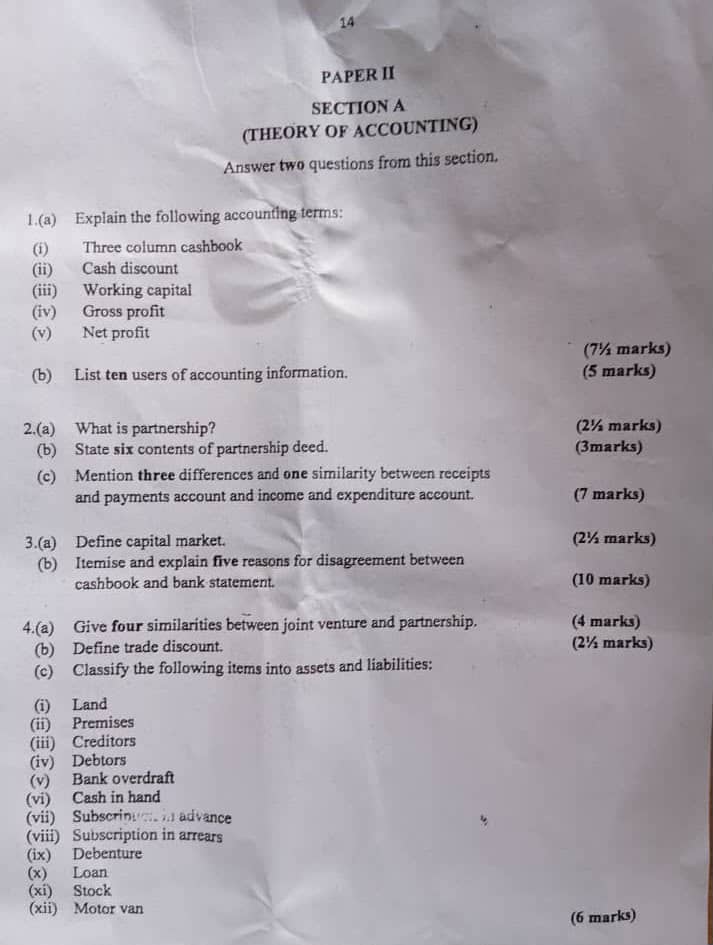
SECTION A: ANSWER TWO QUESTIONS FROM THIS SECTION
===================================================
(1ai)
Three Column Cash Book: A Three Column Cash Book is a special book of original entry used to record all cash and bank transactions of a business. It contains three columns on both the debit and credit sides namely the Cash Column, Bank Column, and Discount Column. The cash column records all cash receipts and payments, the bank column records all money paid into or withdrawn from the bank, while the discount column records discounts allowed and discounts received. It serves as both a cash book and a bank account.
(1aii)
Cash Discount: A Cash Discount is a reduction in the amount payable granted by a seller to a buyer as an incentive for making payment promptly or before the agreed due date. It encourages customers to settle their debts early, improves cash flow, and reduces the risk of bad debts.
(1aiii)
Working Capital is the excess of a business’s current assets over its current liabilities. It represents the amount of funds available for the day-to-day operations of the business. Adequate working capital enables a business to pay its short-term obligations, purchase inventory, and maintain smooth business operations. Formula: Working Capital = Current Assets − Current Liabilities.
(1aiv)
Gross Profit: Gross Profit is the profit a business earns after deducting the cost of goods sold from the total sales revenue. It shows how efficiently the business is producing or purchasing and selling its goods before operating expenses are deducted. Formula: Gross Profit = Sales − Cost of Goods Sold.
(1av)
Net Profit: Net Profit is the final profit made by a business after deducting all operating expenses, administrative expenses, selling and distribution expenses, interest, depreciation, and taxes from the gross profit. It represents the actual earnings of the business available to the owner or shareholders. = Gross Profit − Operating Expenses.
(1b)
(i) Business owners (Proprietors)
(ii) Managers
(iii) Shareholders
(iv) Creditors (Suppliers)
(v) Debtors (Customers)
(vi) Investors (Potential Investors)
(vii) Banks and other financial institutions
(viii) Government and tax authorities
(ix) Employees and trade unions
(x) Researchers and financial analysts
===================================================
(2a)
A partnership is a form of business organization in which two or more persons agree to contribute capital, skills, or labour to establish and manage a business with the aim of making and sharing profits and losses according to an agreed ratio. The relationship is governed by a partnership deed.
(2b)
(PICK ANY SIX)
(i) Name and address of the partnership.
(ii) Names and addresses of the partners.
(iii) Amount of capital contributed by each partner.
(iv) Profit and loss sharing ratio.
(v) Rate of interest on capital and drawings.
(vi) Salaries, commissions, or allowances payable to partners.
(vii) Duties, rights, and responsibilities of each partner.
(viii) Procedure for admission, retirement, or death of a partner.
(2c)
=Differences=
(PICK ANY SIX)
(i) Receipts and Payments Account records both capital and revenue items, while Income and Expenditure Account records only revenue items.
(ii) Receipts and Payments Account is prepared on a cash basis, while Income and Expenditure Account is prepared on an accrual basis.
(iii) Receipts and Payments Account records all cash received and paid during the period whether they relate to the current year or not, while Income and Expenditure Account records only income and expenses relating to the current accounting period.
(iv) Receipts and Payments Account begins with the opening cash and bank balances and ends with the closing cash and bank balances, while Income and Expenditure Account begins with income and ends with either surplus or deficit.
(v) Receipts and Payments Account is similar to a cash book, while Income and Expenditure Account is similar to a profit and loss account.
(vi) Receipts and Payments Account does not include outstanding or prepaid items, while Income and Expenditure Account includes accrued, prepaid, outstanding, and outstanding expenses where necessary.
=Similarity=
(PICK ANY ONE)
(i) Both are prepared by non-profit-making organizations to summarize their financial transactions and assess their financial performance during an accounting period.
(ii) Both are prepared from information obtained from the accounting records of the organization to determine its financial position.
(iii) Both contain records of income and expenses relating to the activities of the organization.
(iv) Both are used by management and other users of accounting information for planning, control, and decision-making purposes
===================================================
(3a)
Capital market is a financial market where long-term funds and securities are raised and traded. It enables governments and companies to obtain long-term capital through the buying and selling of shares, debentures, bonds, and other long-term securities.
(3b)
(PICK ANY FIVE)
(i) Unpresented Cheques: Unpresented cheques are cheques issued by the business and recorded in the cash book but have not yet been presented to the bank for payment by the payees. As a result, they reduce the cash book balance immediately but do not affect the bank statement until they are presented and cleared.
(ii) Uncredited Cheques (Outstanding Lodgements): These are cheques received from customers and paid into the bank by the business but have not yet been processed or credited by the bank. They appear in the cash book but are not reflected in the bank statement until the bank clears them.
(iii) Bank Charges: Banks deduct charges for services such as account maintenance, cheque books, SMS alerts, and transfers directly from customers’ accounts. These deductions appear in the bank statement before the business records them in the cash book, causing a temporary difference.
(iv) Direct Credits: A customer or another person may pay money directly into the business bank account without informing the business immediately. Such deposits appear first in the bank statement and are only entered into the cash book after the business becomes aware of them.
(v) Direct Debits or Standing Orders: The bank may make payments on behalf of the account holder, such as electricity bills, insurance premiums, subscriptions, loan repayments, or standing orders. These payments reduce the bank balance immediately but may not be recorded in the cash book until the business receives the bank statement.
(vi) Dishonoured Cheques: A cheque previously deposited into the bank may be returned unpaid because of insufficient funds, a wrong signature, or other reasons. The bank reverses the amount from the account, causing a difference until the cash book is updated.
(vii) Errors in the Cash Book: Mistakes such as omission of entries, wrong figures, double posting, overcasting, undercasting, or recording transactions on the wrong side of the cash book can result in differences between the cash book and the bank statement.
(viii) Errors Made by the Bank: Sometimes the bank may mistakenly debit or credit the customer’s account with the wrong amount or post another customer’s transaction into the account. Such errors create disagreement between the cash book and the bank statement until they are identified and corrected.
===================================================
(4a)
(PICK ANY FOUR)
(i) Both involve two or more persons who come together to carry on a business with the aim of making profit.
(ii) Both require the parties to contribute capital, skills, labour, or other resources towards the operation of the business.
(iii) Both share profits and losses among the parties according to an agreed ratio.
(iv) Both are established through an agreement which states the terms and conditions governing the business relationship.
(v) Both require mutual trust, honesty, and cooperation among the parties for the successful operation of the business.
(vi) Both require proper books of account to record business transactions and determine profit or loss.
(vii) Both involve joint ownership and management of the business by the parties unless otherwise agreed.
(viii) Both create an agency relationship in which each party can act on behalf of the others in matters relating to the business.
(4b)
Trade discount is a reduction in the listed or catalogue price of goods granted by a seller to a buyer, usually because of bulk purchases or trade relationships. It is deducted before payment is made and is not recorded in the books of account.
(4c)
=Assets=
(i) Land
(ii) Premises
(iii) Debtors
(iv) Cash in hand
(v) Subscription in arrears
(vi) Stock
(vii) Motor van
=Liabilities=
(i) Creditors
(ii) Bank overdraft
(iii) Subscription in advance
(iv) Debenture
(v) Loan
===================================================
*NECO ACCOUNTING*
(2a)
(PICK ANY ONE)
A partnership is a business organization in which two or more persons agree to contribute capital, share profits and losses, and jointly own and manage a business in accordance with the terms contained in a partnership agreement or deed.
OR
A partnership is the relationship that exists between two or more persons who carry on a lawful business together with the intention of making profit and sharing the profits or losses according to an agreed ratio.
(2b)
(PICK ANY SIX)
(i) Name and address of the partnership business.
(ii) Names and addresses of the partners.
(iii) Amount of capital contributed by each partner.
(iv) Profit and loss sharing ratio.
(v) Interest on capital.
(vi) Interest on drawings.
(vii) Salaries or commissions payable to partners.
(viii) Duties and powers of each partner.
(ix) Admission and retirement of partners.
(2c)
DIFFERENCES:
(PICK ANY THREE)
(i) Receipts and Payments Account records all cash receipts and payments, while Income and Expenditure Account records only revenue income and expenditure.
(ii) Receipts and Payments Account includes both capital and revenue items, while Income and Expenditure Account includes only revenue items.
(iii) Receipts and Payments Account is prepared on a cash basis, while Income and Expenditure Account is prepared on an accrual basis.
(iv) Receipts and Payments Account records transactions relating to past, present and future periods, while Income and Expenditure Account records transactions relating only to the current accounting period.
(v) Receipts and Payments Account starts with the opening cash and bank balances and ends with the closing balances, while Income and Expenditure Account begins with income and ends with surplus or deficit.
(vi) Receipts and Payments Account is a summary of cash transactions, while Income and Expenditure Account is similar to a profit and loss account.
(vii) Receipts and Payments Account does not show surplus or deficit directly, while Income and Expenditure Account reveals whether the organization made a surplus or incurred a deficit.
(viii) Receipts and Payments Account contains no adjustments for outstanding or prepaid items, while Income and Expenditure Account includes adjustments for accrued and prepaid income and expenses.
(ix) Receipts and Payments Account is prepared from the cash book, while Income and Expenditure Account is prepared from the adjusted trial balance and other accounting records.
SIMILARITIES:
(PICK ONE)
(i) Both are prepared mainly by non-profit-making organizations such as clubs, schools and charities.
(ii) Both are used to summarize the financial activities of an organization for a particular accounting period.
(iii) Both help in the preparation and presentation of the organization’s final accounts and financial reports.
==========================================
*NECO ACCOUNTING*
(3a)
(PICK ANY ONE)
Capital market is a financial market where long-term funds and securities such as shares, bonds and debentures are bought and sold. It provides long-term finance for businesses and government agencies for investment and expansion.
OR
Capital market is a segment of the financial system that mobilizes and channels long-term capital from savers to individuals, companies and governments through the issue and trading of long-term securities
(3b)
(PICK ANY FIVE)
(i) Unpresented cheques: These are cheques issued by the business and entered in the cash book but not yet presented to the bank by the payees for payment. As a result, the bank has not deducted the amount, causing the bank statement balance to differ from the cash book balance.
(ii) Uncredited lodgements: These are cash or cheques paid into the bank and recorded in the cash book but not yet processed or credited by the bank. Until the bank credits the deposit, the amount will not appear on the bank statement, creating a difference.
(iii) Bank charges: Banks deduct charges for services such as account maintenance, cheque processing and transfers directly from customers’ accounts. If the business has not yet recorded these charges in the cash book, the two balances will disagree until adjustments are made.
(iv) Direct credits: Customers or other persons may pay money directly into the business bank account without informing the business immediately. The bank records the payment at once, but the business may not enter it in the cash book until later.
(v) Standing orders: A standing order is an instruction given to the bank to make regular payments on behalf of the account holder. The bank records these payments automatically, but if the business has not updated its cash book, disagreement will occur.
(vi) Direct debits: Direct debits allow organizations to collect payments directly from a customer’s bank account. The bank records these withdrawals immediately, but if the business has not entered them in the cash book, the balances will differ.
(vii) Dishonoured cheques: A cheque deposited by the business may be returned unpaid because of insufficient funds or other reasons. The bank reverses the credit, but if the business has not yet recorded the dishonour, the balances will disagree.
(viii) Interest credited or charged by the bank: The bank may credit interest on deposits or charge interest on overdrafts directly to the account. If these entries have not yet been made in the cash book, the balances shown by both records will not agree.
(ix) Errors in the cash book: Mistakes such as omissions, overcasting, undercasting, posting wrong amounts or recording transactions incorrectly in the cash book can result in differences between the cash book balance and the bank statement balance.
(x) Errors in the bank statement: The bank may occasionally make mistakes such as posting wrong figures, omitting transactions or making calculation errors. Such errors cause the bank statement balance to differ from the balance shown in the cash book.
(xi) Credit transfers received: Money transferred electronically into the business bank account may be recorded by the bank before the business becomes aware of it. Until the business updates the cash book, the balances in both records will not agree.
(xii) Electronic payments or debit transfers: Payments made through electronic transfers, ATM withdrawals or online banking may be reflected immediately on the bank statement. If they have not yet been entered in the cash book, a difference between the two balances will arise.
================================
*NECO ACCOUNTING*
(4a)
SIMILARITIES:
(PICK ANY FOUR)
(i) Both involve two or more persons coming together to carry on a business.
(ii) Both are established with the main objective of making profit.
(iii) Both require the partners or venturers to contribute capital or resources.
(iv) Both share profits and losses according to an agreed ratio.
(v) Both are based on mutual trust and good faith among the parties.
(vi) Both keep accounting records to determine profit or loss.
(vii) Both may be governed by a written agreement.
(4b)
(PICK ANY ONE)
Trade discount is a reduction in the listed or catalogue price of goods allowed by a seller to a buyer, usually because of bulk purchases or regular patronage. It is deducted before payment is made and is not recorded in the books of account.
OR
Trade discount is an allowance or deduction granted by a seller to a buyer from the catalogue or list price of goods, mainly to encourage bulk purchases or maintain customer loyalty. It is deducted before the invoice is prepared and does not appear in the accounting records.
(4c)
ASSETS:
(i) Land
(ii) Premises
(iii) Debtors
(iv) Cash in hand
(v) Subscription in arrears
(vi) Stock
(vii) Motor van
LIABILITIES:
(i) Creditors
(ii) Bank overdraft
(iii) Subscription in advance
(iv) Debenture
(v) Loan
=======================================
SECTION B – Neco 2026 Financial Accounting Questions & Answers


