
 08131323935 |
  08131323935

Welcome to “Naijaclass Academy“ For Neco GCE 2025 Government Questions Answers Expo
If you’re preparing for the Neco GCE 2025 Government Questions Answers Exam, this updated guide from Naijaclass.com will help you score high with verified questions and solved answers.
Friday 12 December
Government III (Objective) – 10:00 am – 11:00 am
Government II (Essay) – 11:00 am – 12:40 pm
========================================
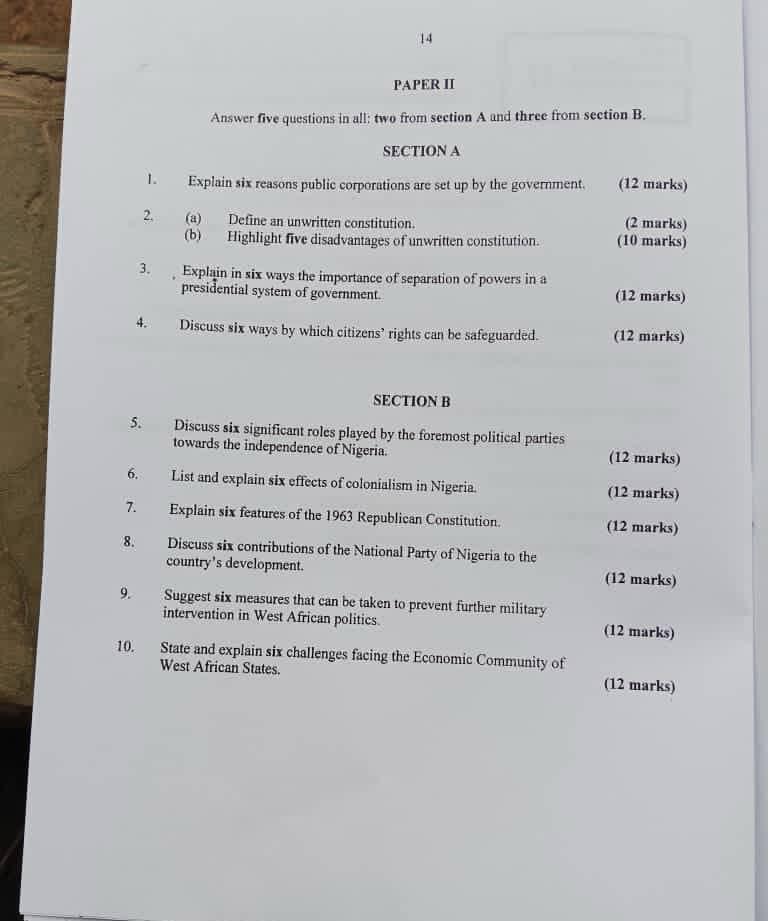
Neco GCE 2025 Government Questions Answers
GOVERNMENT OBJ
01-10: CCBEAACBEB
11-20: ACBBBBACBA
21-30: ABACCACCCB
31-40: EDDEBAAECD
41-50: BAEBDDDABB
51-60: BDBEEEBBEC
====================================
(1)
(PICK SIX ONLY)
(i) Provision of essential services: Public corporations are established mainly to supply essential services such as electricity, water supply, transport and communication. These services are so important to the welfare and daily survival of the people that the government must ensure they are available, reliable, affordable and spread across both urban and rural areas. Without these services, national development would be slow and life would be difficult.
(ii) To prevent exploitation: If essential services are left completely in the hands of private individuals, they may charge excessively high prices or provide poor-quality services for personal gain. Since their main aim is profit, they may neglect the needs of the masses. Government-run corporations therefore help to prevent such exploitation, maintain fair pricing, and protect the public interest by placing people’s welfare above profit.
(iii) Huge capital involvement: Some projects, like building railways, dams or waterworks, require very large capital investment that private individuals may not be able or willing to provide due to the high risk and long time needed to recover costs. The government sets up public corporations to handle these capital-intensive ventures because only the state has the financial strength and long-term capacity to fund such essential national projects.
(iv) Provision of employment: One important reason for establishing public corporations is to create employment opportunities for the citizens. These corporations usually employ thousands of workers at different skill levels, from professionals to artisans. This helps to reduce unemployment, raise household income, and improve the economic well-being of many families. It also contributes to social stability.
(v) Raising people’s standard of living: When essential services such as electricity, water and transportation are provided regularly and efficiently, productivity increases, businesses grow, and life becomes more comfortable. Stable services reduce stress, save time, improve health and support education. All these factors lead to an overall improvement in the standard of living of the people and promote a better quality of life.
(vi) For economic growth: Efficient functioning of public corporations boosts industrial and commercial activities. When there is steady power supply, good transport systems and reliable communication networks, industries can operate smoothly. This encourages both local and foreign investors to invest in the economy, which in turn promotes economic growth, job creation and national development.
(vii) Strategic projects: Some industries are too sensitive or security-related to be left in private hands, such as currency printing, arms production or defence-related communication. Public corporations are created to manage these strategic sectors to protect national security and ensure that such critical services do not fall into the wrong hands. This helps maintain national stability and sovereignty.
(viii) Revenue generation: The government may also set up public corporations to generate revenue through the sale of goods and services such as electricity bills, water charges and transport fares. Profits made by these corporations can be used to fund development projects, support government programmes and strengthen the national budget. Even when profit is not the main aim, the revenue generated still assists national finances.
==============================
(2a)
An unwritten constitution is one in which the fundamental principles, powers and structures of government are not contained in a single codified document. Instead, the constitution is drawn from several sources such as statutes passed by parliament, judicial decisions, long-established customs, traditions and political conventions that guide the operation of government.
OR
An unwritten constitution refers to a system where the basic laws, customs, conventions, rules and practices that govern a country are not written down together in one formal document. Rather, they exist in different sources and evolve over time through usage, court judgments and historical development.
(2b)
(PICK FIVE ONLY)
(i) No checks and balances: An unwritten constitution does not firmly establish checks and balances because the powers of each arm of government are not clearly stated in one document. This weakens the ability of the judiciary and legislature to properly control the executive, allowing government officials to overstep their boundaries.
(ii) Possibility of arbitrary government: Since many rules are based on customs and traditions rather than a fixed written law, political leaders may use their discretion to interpret these conventions in ways that favour them. This can lead to arbitrary actions, abuse of power, and decisions that are not guided by clear constitutional limits.
(iii) Encouragement of arbitrary changes: Because parliament is supreme in an unwritten constitution, it can easily change important constitutional practices without following strict amendment procedures. This flexibility, although useful, creates room for manipulation, allowing leaders to alter the rules whenever it suits their political agenda.
(iv) Not easily known by citizens: The fact that the constitution is scattered across different sources makes it difficult for ordinary citizens to know exactly what the constitution says. This lack of awareness weakens civic education and makes people less informed about their rights and obligations.
(v) No ease of reference: Since the constitution is not contained in a single document, it cannot be easily consulted or studied. Students, researchers and even government officials may have to go through many materials to understand constitutional issues, making interpretation slow and sometimes confusing.
(vi) Violation of citizens’ rights: Without a clearly written document listing fundamental rights, political leaders may tamper with citizens’ freedoms without clear restrictions. This weakens the protection of individual rights and makes it easier for governments to undermine civil liberties.
(vii) Difficulty in seeking redress: Because citizens cannot point to one clear document showing their constitutional rights, it becomes harder to challenge the government when those rights are violated. Courts may also struggle to depend on scattered conventions, which makes justice slower and sometimes less certain.
==============================
(4)
(PICK SIX ONLY)
(i) Law: Supremacy and existence of law help to maintain the rights of individuals and their corresponding obligations. When laws are clearly stated and applied equally to everyone, it prevents oppression, protects citizens from arbitrary actions, and ensures that no one’s rights are violated without legal consequences.
(ii) Independent Judiciary: Judges must be fair, impartial and free from government control in order to protect individuals’ rights against invasion by private individuals or the government. An independent judiciary ensures that justice is served and that every citizen can seek redress when their rights are infringed.
(iii) Democracy: Democracy in a modern political system permits free discussion, freedom of association, and participation in decision-making. This system of government allows people to express their opinions freely and challenge any action that may threaten their rights.
(iv) Entrenchment of Human Rights: Fundamental human rights should be clearly entrenched in the constitution of the land. When these rights are written in the constitution, they become protected by law, and no government or individual can easily remove or alter them without due constitutional process.
(v) Enlightenment Programme: This programme helps educate citizens to be conscious of their rights and how to defend them. Through civic education, campaigns, seminars and public awareness programmes, people learn how to report abuses, demand justice and insist on their constitutional freedoms.
(vi) Literacy Level: The literacy level of citizens should be improved upon, for example, through organising adult education classes and other educational programmes. When people can read and write, they are better informed about their rights and can easily understand laws, government actions and how to protect themselves from exploitation.
(vii) Free Press: Freedom of the press should be guaranteed so newspapers, radio, television, and online media can report issues objectively. A free press exposes abuses of power, human rights violations, and injustices, thereby helping to protect the rights of citizens.
(viii) Existence of Human Rights Commission: Bodies such as the Ombudsman (Public Complaints Commission), National Human Rights Commission and parliamentary committees help to protect citizens’ rights. These institutions investigate complaints, defend the oppressed, and ensure that public officials respect the rights of the people.
============================
(5)
(PICK ANY FIVE)
(i) Mobilizing Nationalist Awareness: Foremost political parties like the NCNC, Action Group (AG), and NPC helped create political awareness across Nigeria. They educated citizens about their rights, the need for self-government, and the disadvantages of foreign rule. Their campaigns inspired unity and awakened Nigerian nationalism.
(ii) Demanding Constitutional Reforms: These parties actively pushed for changes in colonial constitutions. They influenced reforms such as the Richards (1946), Macpherson (1951), and Lyttleton (1954) constitutions, each of which gave Nigerians more political power. Their pressure gradually shifted control from the British to Nigerians.
(iii) Participation in Legislative Councils: Political parties contested elections and won seats in regional and central legislatures. Their presence in these assemblies enabled them to challenge colonial policies, oppose unjust laws, and argue strongly for independence through official channels.
(iv) Formation of National Movements and Alliances: Political parties formed alliances such as the National Council of Nigeria and the Cameroons (NCNC) and later collaborated across regions. These alliances strengthened the national struggle and presented a united front to the British, making it harder for the colonial government to ignore their demands.
(v) Organizing Protests, Strikes, and Campaigns: Parties supported or organized peaceful protests, strikes, rallies, and petitions against colonial injustices. Actions like the 1945 general strike and anti-tax protests pressured the British administration and accelerated the push for political freedom.
(vi) Producing Nationalist Leaders: Parties served as platforms for grooming strong nationalist leaders such as Nnamdi Azikiwe (NCNC), Obafemi Awolowo (AG), and Ahmadu Bello (NPC). These leaders played leading roles in negotiating independence, representing Nigerian interests, and guiding constitutional conferences.
(vii) Promoting Political Education and Press Freedom: Through newspapers like the West African Pilot (NCNC) and other party publications, political parties spread nationalist ideas, criticized colonial rule, and encouraged political debate. This helped build a politically conscious population that supported independence.
(viii) Negotiating Independence with the British: Political parties actively participated in constitutional conferences held in London and Lagos. Their leaders negotiated for full self-government, federalism, regional autonomy, and finally complete independence on October 1, 1960. Without these negotiations, independence would have been delayed.
(6)
(PICK ANY SIX)
(i) Introduction of Western Education: Colonial rule brought formal Western-style education to Nigeria. Missionaries and colonial administrators established schools, which produced the first generation of Nigerian lawyers, teachers, doctors, and politicians. This education created an educated elite who later led the independence struggle.
(ii) Creation of New Political Structures: The British introduced modern political systems such as the civil service, legislative councils, and regional governments. These structures laid the foundation for Nigeria’s present administrative and political order, although they sometimes favored British interests more than Nigerian unity.
(iii) Economic Exploitation and Cash-Crop Production: Nigeria’s economy was reorganized to benefit Britain. The colonial government promoted cash crops like cocoa, groundnuts, cotton, and palm oil for export. This led to the exploitation of Nigeria’s natural resources and created a one-sided economy built mainly on exporting raw materials.
(iv) Introduction of New Transportation Systems: The British built roads, railways, and ports to transport goods from production areas to the coast for export. Although built mainly for economic exploitation, these infrastructures later supported Nigeria’s internal trade and national development.
(v) Cultural Changes and Loss of Traditional Values: Colonialism weakened indigenous cultures, languages, and traditions. Western lifestyles, Christianity, and European values were promoted, while many local customs were discouraged or labeled as “primitive.” This led to cultural blending as well as cultural erosion.
(vi) Creation of Artificial Boundaries and Forced Unity: Nigeria was formed by merging diverse ethnic groups with little consideration for historical or cultural differences. This artificial union created long-term ethnic tensions and competition, which still affect Nigeria’s political stability today.
(vii) Introduction of Cash-Taxation System: The British introduced direct taxes to fund colonial administration. This forced Nigerians into wage labor and cash-crop farming to earn money for taxes. The taxation system changed local economies and reduced the influence of traditional rulers.
(viii) Development of Urban Centers: Colonialism led to the growth of towns and cities such as Lagos, Ibadan, Enugu, and Kaduna. These areas became centers of administration, commerce, education, and social interaction, shaping Nigeria’s modern urban system.
(7)
(PICK ANY SIX)
(i) Nigeria Became a Republic: The 1963 Constitution officially ended all constitutional ties with Britain by removing the Queen as the head of state. This meant Nigeria now controlled its own political system completely, without any external authority influencing national affairs.
(ii) Establishment of a Ceremonial President: A Nigerian President replaced the British Monarch, but the President’s role was largely symbolic. He acted as the head of state with limited powers, such as representing the nation and performing official ceremonies, but he did not control government policies.
(iii) Prime Minister as Head of Government: Executive powers were vested in the Prime Minister, who was the leader of the majority party in the House of Representatives. He appointed ministers, directed national policies, and managed the day-to-day running of government, making the system purely parliamentary.
(iv) Federal Structure Maintained: The constitution continued the federal arrangement that divided powers between the central government and the four regions, Northern, Western, Eastern, and Mid-Western. Each level had clearly defined responsibilities, allowing the regions to manage many local affairs independently.
(v) Bicameral Legislature (Two-House Parliament): The National Assembly had two chambers, the Senate and the House of Representatives. Laws had to pass through both houses. This structure strengthened lawmaking, allowed better representation, and ensured checks and balances within the legislature.
(vi) Protection of Fundamental Human Rights: The constitution guaranteed rights such as freedom of movement, speech, expression, religion, and fair hearing. These rights aimed to protect citizens from misuse of power and promote democratic governance across the country.
(vii) Supreme Court as Final Court of Appeal: The constitution ended the practice of appealing cases to the British Privy Council. The Nigerian Supreme Court became the highest legal authority, strengthening national judicial independence and giving Nigeria full control of its legal system.
(viii) Regional Autonomy: Regions enjoyed considerable independence and could legislate on matters like agriculture, education, and local government. Each region had its own Premier and House of Assembly, allowing them to make decisions according to regional needs and priorities.
(8)
(PICK ANY SIX)
(i) Promotion of National Unity: The NPN was known for its national outlook. It brought together politicians from different ethnic groups and regions, helping to reduce ethnic politics and strengthen national integration during the Second Republic (1979–1983).
(ii) Expansion of Agriculture through the Green Revolution: The NPN government introduced the Green Revolution programme to boost food production, provide fertilizers, improve farming methods, and reduce Nigeria’s dependence on food imports. This helped modernize agriculture.
(iii) Development of Education: The NPN expanded access to education by establishing more schools, colleges of education, and universities. It increased funding for education and supported adult literacy programs during its tenure.
(iv) Growth of the Transportation Sector: The party improved transportation by investing in roads, highways, and rail lines. Major road networks were constructed or rehabilitated to improve movement of goods and people across the country.
(v) Development of Housing Projects: The NPN implemented large-scale housing schemes through the Federal Housing Authority to provide low-cost and affordable housing. Many estates were built in cities such as Lagos, Kaduna, and Abuja.
(vi) Promotion of Industrial Development: The NPN government encouraged industrial growth by establishing new industries, supporting local manufacturing, and attracting foreign investors. Industrial estates and manufacturing plants increased under its rule.
(vii) Expansion of Telecommunication Services: Telecommunication facilities were improved and expanded during the NPN era. More telephone exchanges, communication towers, and postal services were developed to connect different regions of the country.
(viii) Strengthening Nigeria’s Foreign Relations: The NPN government pursued active foreign policies, joined international organizations, and strengthened diplomatic ties with African and Western countries. This enhanced Nigeria’s image and influence globally.
==================================
(9)
(PICK ANY SIX)
(i) Strengthening Democratic Institutions: Countries must build strong institutions like the judiciary, parliament, and electoral bodies. When these institutions function properly and handle disputes fairly, it reduces the weakness in governance that often invites military intervention.
(ii) Promoting Free, Fair, and Credible Elections: Regular and transparent elections help to maintain political stability. When citizens trust election results, there is less tension and fewer excuses for soldiers to step in claiming that leaders lack legitimacy.
(iii) Improving Good Governance and Accountability: Civilian governments need to reduce corruption, manage public resources responsibly, and be accountable to the people. Good governance builds public trust and removes the conditions that make coups seem like a solution.
(iv) Professionalizing and Reforming the Military: The military should be trained to respect constitutional order and stay out of politics. Improving their welfare, discipline, and loyalty to democratic values helps prevent them from seeing political power as an option.
(v) Strengthening Regional and International Pressure: ECOWAS, the African Union, and other international bodies should continue to impose sanctions, suspend coup regimes, and apply diplomatic pressure. Strong regional responses discourage future military takeovers.
(vi) Encouraging Inclusive Governance: When all ethnic, political, and social groups are given a voice in government, political grievances reduce. This prevents the military from claiming they are intervening to “restore fairness” or “protect the people.”
(vii) Economic Stability and Development: Developing the economy, creating jobs, and reducing poverty help minimize frustration among citizens. Stable societies experience fewer political crises that may give the military an excuse to intervene.
(viii) Early Conflict Resolution and Dialogue: Political disagreements should be resolved quickly through dialogue and mediation. When tensions are managed early, crises do not escalate into situations that attract military involvement.
===================================
(10)
(PICK ANY SIX)
(i) Political Instability: Many ECOWAS countries experience frequent coups, election disputes, and unstable governments. These political crises disrupt regional planning and make it difficult for ECOWAS to enforce decisions, maintain unity, or carry out peacekeeping operations effectively.
(ii) Insecurity and Terrorism: West Africa faces serious security threats such as Boko Haram, jihadist insurgencies, kidnapping, banditry, and piracy. These security problems destroy lives and property, discourage foreign investment, and force ECOWAS to spend huge amounts on peacekeeping instead of development.
(iii) Poor Infrastructure Development: Most member states lack good roads, strong electricity supply, and modern communication networks. These poor facilities slow down transportation of goods, increase the cost of doing business, and make regional trade less efficient, weakening economic integration.
(iv) Low Level of Industrialization: ECOWAS economies mainly depend on exporting raw materials like crude oil, cocoa, cotton, and minerals. The region lacks strong manufacturing industries that can add value to these resources. This reduces job opportunities, limits economic growth, and increases dependence on foreign products.
(v) Corruption and Weak Governance: Corruption is a major challenge in many ECOWAS countries. Public funds are often mismanaged, and institutions are weak. This reduces public trust, discourages investors, and makes it difficult for ECOWAS to implement development projects and regional agreements.
(vi) Trade Barriers and Border Restrictions: Even though ECOWAS promotes free movement of people and goods, many countries still impose tariffs, create roadblocks, and demand unnecessary documents at borders. These barriers slow down trade, encourage smuggling, and prevent the smooth operation of the ECOWAS common market.
(vii) Economic Inequality Among Member States: There is a wide gap in economic strength among ECOWAS countries. For example, Nigeria’s economy is much bigger than many smaller states. This imbalance creates dependency, affects decision-making, and sometimes leads to disagreements over contributions and shared responsibilities.
(viii) Inadequate Funding: ECOWAS relies heavily on financial contributions from member states, but many countries fail to pay their dues on time. This lack of regular funding limits the organization’s ability to carry out peacekeeping missions, implement development programs, and maintain regional institutions.


Be the first to comment